Year 3
Welcome to Year 3
Class Teacher - Miss Taylor
Teaching Assistant - Miss Dury


Maths
During the first week of half-term, we revisited fractions, developing our understanding of parts and wholes. We learnt that some fractions are equivalent even though they look different. We used fraction walls, bar models and diagrams to identify and compare equivalent fractions. Pupils explored how fractions can represent the same amount. Next, we added and subtracted fractions with the same denominator. We used practical equipment and visual models to support our understanding and solved simple fraction calculations and word problems. Pupils explained how the denominator stays the same while the numerator changes.
This week, we explored money, taking our time to recognise the value of different coins and notes. We then used pounds and pence to make amounts. We added and subtracted money, including giving change and solving practical problems linked to real-life situations such as shopping. Children applied their money skills to reasoning and problem-solving activities. They compared prices, calculated totals and worked out change from different amounts. Pupils used mental and written methods to solve multistep money problems accurately.
In week 5, children learnt to tell and write the time from both analogue and digital clocks. They explored a.m. and p.m., read time to the nearest minute and used vocabulary such as past and to. Pupils also compared durations of time. We then explore reading Roman numerals. During our final week of this half-term, we solved problems involving time, including calculating durations, start times and end times. We used our understanding of hours and minutes to solve real-life challenges and developed confidence in explaining their methods and checking answers.
Religious Education
During this half-term, children learnt about the Ascension and how Jesus Christ returned to the Father after His Resurrection. They explored how His disciples felt and discussed the promise that the Holy Spirit would come to help and guide them. Pupils reflected on how we continue the work of Jesus today. We researched Pentecost and how the Holy Spirit gave the disciples courage to share the Good News with others. We explored the symbols of fire and wind and reflected on how we are strengthened to help others and live out our faith. This week, we discovered how the disciples travelled “to the ends of the earth” to share the message of Jesus. We learnt about the early Church and how Christians today continue to spread love, hope and peace through their words and actions. Pupils linked this learning to the Catholic Social Teaching principle of solidarity. We learnt that the Church has a mission to care for people, welcome others and serve communities around the world and explored examples of missionaries, charities and local acts of service that show God’s love in action. We reflected on ways they can make a positive difference in our own community.
This week, we explored the Fruits of the Holy Spirit, including love, kindness, peace and self-control. Pupils discussed how these qualities help people build strong relationships and make thoughtful choices. We reflected on how we can show these virtues in school, at home and in the wider world and how we are called to continue the mission of Jesus by caring for others and sharing God’s love. We explored Catholic Social Teaching themes such as human dignity, stewardship and the common good. To end the half-term, we discussed how we can be peacemakers, helpers and responsible members of God’s family.

Maths
During the first week of half-term, pupils learnt that fractions show equal parts of a whole. We explored unit fractions such as 1/2, 1/3, 1/4, 1/5 and 1/10 using shapes, objects and pictures. Pupils practised recognising and finding fractions of amounts and developed their understanding of the numerator and denominator.
In week 2, children compared and ordered fractions with the same denominator. We used number lines, bar models and practical resources to decide which fractions were greater or smaller. Pupils also counted up and down in tenths and connected fractions to division. This week, we found fractions of numbers and quantities by sharing into equal groups. We solved practical and reasoning problems involving halves, thirds, quarters and tenths of amounts. Pupils explained their methods using mathematical vocabulary and pictorial representations.
In week 4, we began to measure and compare mass using grams (g) and kilograms (kg). We estimated, weighed and recorded the mass of different objects using scales. Pupils also added and subtracted amounts of mass and solved word problems involving weight. We explored capacity and volume using litres (l) and millilitres (ml). We measured, compared and added amounts of liquid using practical equipment. Pupils developed their understanding of equivalent amounts and solved problems involving capacity. This week, children applied their knowledge of mass and capacity to solve multi-step problems. They interpreted scales, estimated sensible measurements and explained their reasoning. Pupils used addition and subtraction to compare measurements and solve real-life mathematical challenges involving weight and volume.
Religious Education
During this half-term, children learnt about Jesus spending forty days in the desert and why this time was important. We explored how we use Lent as a time for prayer, fasting and helping others. Pupils reflected on ways they can grow closer to God during Lent. We explored the story of the temptations of Jesus and discussed how He chose to follow God’s will. We reflected on making positive choices in our own lives and how prayer can help people when facing challenges. Pupils linked this learning to the Catholic Social Teaching principle of living with dignity and respect. We explored how we all show love and care for others through charitable acts, helping those in need and helping those around us. Pupils considered ways they could support their families, school and the wider community. We explored Holy Week, including Palm Sunday, the Last Supper, Good Friday and Easter Sunday and explored how these events show sacrifice, hope and God’s love for the world. Pupils reflected on the importance of forgiveness and service to others.
Next, we explored the meaning of the garden in the Easter story, including the Garden of Gethsemane and the empty tomb on Easter morning. We reflected on how the Resurrection brings hope, new life and joy to people around the world. Pupils linked this learning to caring for God’s creation and living peacefully with others. To end this unit, we reflected on how the teachings of Jesus encourage people to care for others, especially those who are poor or vulnerable. We explored Catholic Social Teaching themes such as stewardship, solidarity and the common good, while discussing practical ways we can show kindness, fairness and compassion in everyday life.
Geography
To start our new Geography topic, we discovered that land is used in different ways depending on people’s needs and the environment. We explored different types of land use, including residential, commercial, agricultural, industrial and recreational land and used maps and photographs to identify how land is used in their local area. Children compared urban and rural areas and explored how land use changes between towns, cities and the countryside. We identified features of each environment and discussed why different types of land use are needed in different places. Pupils used geographical vocabulary to describe human and physical features. Children learnt about agricultural land use and explored how land is used for farming. We investigated different types of farming and discussed how food is produced. In week 4, children explored how land is used for industry, shops, offices and transport. They discussed why factories, warehouses and businesses are often built in particular locations. Pupils investigated how roads, railways and ports support trade and movement. We learnt about land used for recreation and conservation, including parks, sports fields and nature reserves and explored the importance of protecting green spaces and considered how people can care for the environment. Finally, we explored how land use changes over time because of population growth, transport, housing and environmental needs. We used maps, aerial photographs and fieldwork skills to compare past and present land use. As a class, we reflected on how communities can balance development with caring for the environment.

Maths
During this half-term, pupils will develop and strengthen their multiplication and division skills. We began our half-term by refreshing the four operations, and on a mission to develop our fluency skills. Today was all about multiplying by 10. Children developed a handy and accurate method, using a place value chart to always be able to multiply by 10. We applied our knowledge to problem-solving and reasoning questions to deepen our understanding. This week, we developed an understanding of multiplying 2-digit numbers by 1-digit numbers. Children became much more confident with new methods as the week progressed and can now demonstrate accuracy and understanding when multiplying 2-digit numbers by 1-digit numbers involving exchanges. This week, we focussed on making links and connections between our multiplication knowledge and our understanding of division. We then applied this to our new learning of dividing a 2-digit number by a 1-digit number.
English
Our first unit in English this half-term is 'writing to inform'. This week, we were introduced to our new class text, Charlotte's Web by E.B. White. Children were excited to share some previously learnt knowledge of the book from watching the film at home with their families. After exploring examples of newspapers, information texts and how to guides, children were able to identify and understand the use of headings and subheadings accurately. Next, we explored the use of articles a and an. We began by using articles for animals, for example, 'a mouse' and 'an elephant', before exploring their uses within our creative writing. This week, we researched bees, dividing the information into different categories ready to support us in our independent writing next week. We discussed how readers respond to eye-catching headings and how we could use alliteration within our own headings to create interest. We also developed alternative and concise subheadings to make our information texts unique and creative. Today, we have developed our understanding of complex sentences, using the subordinating conjunctions 'although' and 'even though' to create sentences about bees for our information texts. This week, we explored generalisers to provide broader information about frequency and we developed an understanding of perfect tense within our writing.
Our second writing unit this half-term is 'writing to create dialogue'. Year 3 are enjoying our class text, Charlotte's Web, and are keen to continue reading each day. Children were asked to imagine being Wilbur the pig from our text. They imagined escaping from the farm and what this would look and feel like. How would you escape? Would anyone help you? Where would you go next? Children displayed excellent levels of imagination and creativity ... I hope your gardens at home do not have any loose fence panels!
Religious Education
In Year 3, children will deepen their understanding of the Gospels and begin to explore who Jesus is, why he came, and what his actions reveal about God’s Kingdom. This week, children learnt that Matthew’s Gospel is one of the four Gospels in the Bible. We found Matthew in the New Testament and explored its structure. Pupils developed an understanding that Matthew was written for a Jewish audience and shows Jesus as the promised Messiah. This week, children retold the story of the Visit of the Magi, showing understanding of key events. They explored the meaning of the gifts of gold, frankincense and myrrh, learning how these gifts reveal important truths about Jesus as king, God’s Son and saviour. This week, pupils learnt that the word Epiphany means reveal. They explored how Jesus was revealed to the Magi and considered other moments in the Gospels when Jesus is revealed to people, helping them understand that Jesus came for everyone. This week, children were introduced to the Kingdom of God. They learnt that it is not a physical place, but God’s way of living. Pupils described what the Kingdom of God is like—such as peace, love, peace, forgiveness and justice. We also explored what it is not. Through the story of Jesus healing the Centurion’s servant, children explored how miracles show Jesus’ power, compassion and authority. We thought about what the miracle tells us about Jesus and discussed the thoughts and feelings of the people involved, developing empathy and reflective thinking.
Music
This week, Year 3 are developing Chord Skills and Rhythm. We focused on expanding chord knowledge and rhythmic control by introducing a new chord, practising smooth chord transitions and exploring louder/softer (dynamics) and tempo.
Science
This week, children learnt that light is needed in order to see and that darkness is the absence of light. They identified different sources of light and began to recognise that light can be dangerous and learn simple rules for staying safe around light sources. This week, children explored how light reflects off some surfaces. They investigated which materials are reflective and which are not, discovering that shiny, smooth surfaces reflect light better than dull ones. Pupils made predictions, observed carefully and began to explain their findings using scientific vocabulary.
Physical Education
One of our units this half-term will be focussing on key fundamental skills of balancing, running, jumping, hopping and skipping. Pupils will develop their ability to change direction with balance and control. They will be given the opportunity to explore how the body moves at different speeds as well as how to speed up and slow down with control. Our key focus this week was to develop balance and apply it to other fundamental movement skills.
Our other PE lessons this half-term will concentrate on developing a variety of ball skills. Children will develop the skills to track a ball when dribbling with hands and feet in addition to developing their throwing and catching skills.

Maths
During this half-term, pupils will develop and strengthen their addition and subtraction skills. Year 3 have worked incredibly hard on mastering efficient methods to add 2-digit and 3-digit numbers together. This week, we developed our understanding of column addition and what to do when we have more than 10 ones. Children are developing their column addition wonderfully and have started to apply their new knowledge and understanding to problem - solving activities.
Year 3 have shown excellent progress this week, mastering efficient methods to subtract a 2-digit number from a 3-digit number. This week, we developed our understanding of column subtraction and what to do when we require exchanging across columns. Children are developing their subtraction knowledge wonderfully and have started to apply their understanding to problem - solving activities.
Today, we explored complements to 100, identifying relationships between numbers. Using our previously learnt methods, children are now beginning to use estimation techniques and use inverse operations to answer questions. We can now make more accurate decisions when puzzling reasoning and problem-solving tasks.
For the remainder of this half-term, we will be learning and developing our multiplication and division understanding. We will still be completing our daily fluency tasks, which include 5 questions using addition, subtraction, division and multiplication followed by a challenge question.
Today, we used concrete resources to show our understanding of equal groups.
After refreshing our understanding of the 2, 5 and 10 times-tables, we used grouping and sharing methods to explore the 3 times-table. We used our understanding of grouping and sharing to multiply and divide by 3. This week, our focus is the 4 times-table. We used grouping and sharing methods to explore the 4 times-table. We used our understanding of grouping and sharing to multiply and divide by 4. After refreshing our understanding of the 2, 5, 10, 3 and 4 times-tables, we used grouping and sharing methods to explore the 8 times-table. We used our understanding of grouping and sharing to multiply and divide by 8.
English
Our first English focus this half term will be writing to create character. This week, we were introduced to our new class text, Planet Omar: Accidental Trouble Magnet by Zanib Mian. This week, we created our own compound sentences using the co-ordinating conjunction 'or'. We also developed our understand and confidence when using commas in a list. We were encouraged to use our fantastic imaginations, just like Omar to create some weird and wonderful examples. Each day, at the beginning of our English lessons, we concentrate on developing our letter formation and handwriting using one of our Year 3 spelling words. We are beginning to understand paragraphs and have been creating our own based on the book we are reading.
This week, we were introduced to similes. At first, these were a little confusing, but they absorbed the lesson like sponges. The concepts soon became as plain as day and we were then able to include these within our imaginative writing. Using all our newly developed skills, we wrote our own diary entries in the style of Omar and his amazing imagination.
Our second writing unit this half-term will be writing to create character. Today, we explored imperative verbs and enjoyed giving out some bossy instructions. We refreshed our understanding of complex sentences, using the subordinating conjunction 'as'. While trying to remember our Year 2 learning objectives, capital letters and full stops, we created a first draft letter to Daniel the bully. Today, we concentrated on developing our understanding of past tense verbs, it is now clear that not all past tense verbs end 'ed'.
Religious Education

In week 1, we explored the question, what is a prophet? Year 3 discovered prophets were special people chosen by God to share His messages with others. They reminded people to listen to God and to care for one another. This teaches us that everyone is important and has a role in God’s plan. Throughout week 2, we discovered the Prophecy of Isaiah. Isaiah told God’s people that a Saviour would one day come to bring light and hope. His message helped people stay hopeful even when life was difficult. Today, we are reminded to share hope with others, especially those who feel sad or alone. We enjoyed learning how God promised to send a Messiah who would bring peace, love, and fairness to the world. We shared how we could try to bring peace love and fairness to the world too. This helped children understand the difference between human promises and God’s faithful promises. It encouraged us to think about how they can act fairly and kindly. During week 4, we discussed the ways in which we put our trust in God, just may Mary put her trust in Him. When the angel Gabriel visited Mary, she trusted God and said “yes” to His plan. Her courage shows us how to listen to God and help bring love into the world. Like Mary, we are invited to take part in God’s plan through our words and actions. Throughout December, Year 3 have explored the importance of Advent. Advent is a special time when we prepare our hearts for Jesus coming. We use symbols like the wreath and candles to help us wait with joy and hope. Advent reminds us to think of others who are waiting or in need and to show kindness.
Advent


Class Worship
As we progress through Year 3, children plan their own class worship celebrations with increasing independence. Children plan their worship in small groups, using the support of the collective worship planner and Let Us Pray cards. By the end of the year, each child will have planned and delivered at least one collective worship. Many children will have planned and delivered multiple worship sessions. Children are becoming increasingly confident when reading scripture, either as a whole class or when leading worship.


Music
This week, we refreshed our previous half-term's learning, building confidence with song sections. We can strum along to short repeated patterns using 1–2 chords. We practised keeping in time with simple music and introduced the rhythm pattern used in Jingle Bells. In week 10, we learnt rhythms using mainly C chord and focussed on steady rhythm and clean chord changes. In week 11 we played along to backing tracks to improve fluency, confidence, and performance skills (starting together and ending together).
Design and Technology
Our topic this half-term is Cooking and Nutrition : Eating Seasonally. This week, we used research methods to explain that fruits and vegetables grow in different countries based on their climates. We were able to identify which fruits and vegetables grow where. We understand that seasonal fruits and vegetables grow in a given season and that eating them in season positively affects the environment. This week, we identified which foods grow in which season within the United Kingdom and began to find recipes that contain seasonal foods.
Remembrance Day


Maths
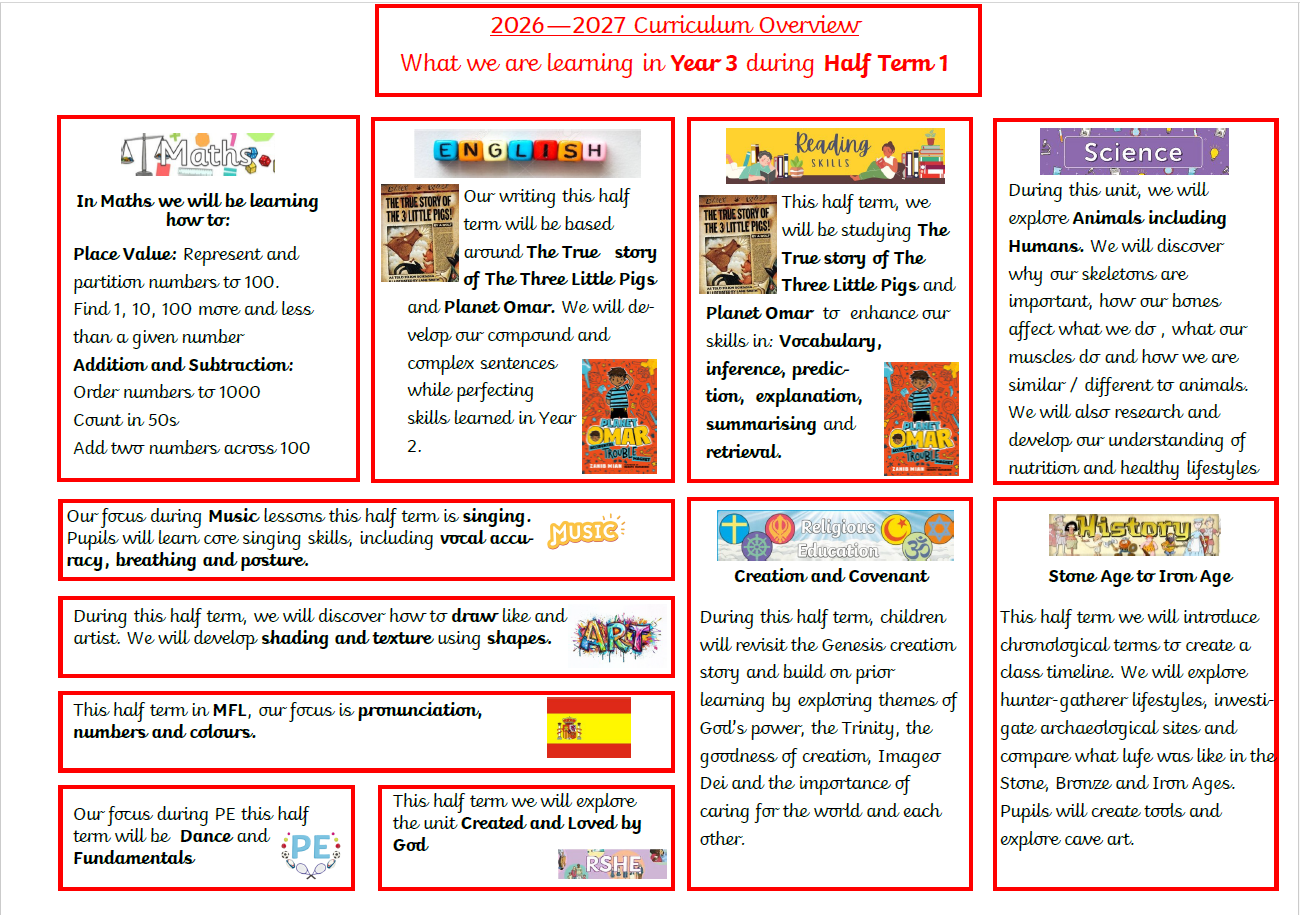
During our first week, Year 3 looked at partitioning numbers up to 100. We created number lines and learnt how to accurately measure length in cm and mm using a ruler. During week 3, pupils started working with 3-digit numbers, counting in hundreds and transferred their partitioning skills to 3 - digit numbers. Pupils can now confidently partition numbers up to 1000. Pupils are beginning to access problem-solving activities to deepen their mathematical learning and strengthen their resilience. Our first half - term has focused primarily on place value, ensuring pupils are confident with number when adding and subtracting. Each day, our day starts with a fluency task. These include 5 questions using addition, subtraction, division and multiplication followed by a challenge question. Children are becoming increasingly confident in accepting the challenge and beginning to take responsibility for their independent learning.
English and Reading Skills
In English, we loved reading The True Story of the Three Little Pigs. This was a perfect class read to begin our new academic year. Children became Alexander the wolf and created their own recounts. Our second book is Fortunately the Milk by Neil Gaiman. We have explored this book within our daily reading skills sessions to develop our fluency, retrieval, prediction, vocabulary and summarising skills. This week, we have developed our knowledge and understanding of verbs,
Library Visits
Year 3's first visit of the academic year to Rawmarsh Library involved creating Stone Age art to add to a cave created by the wonderful Wendy and Sonia.


Religious Education
Year 3 explored Haiku poems. We created two Haiku poems as a class to reflect parts of the Genesis Creation story. Pupils then worked individually or as part of a team to create their own poems.

Science
In Science, we are now able to name some bones accurately and understand how our skeletons protect and support us, in addition to creating the movements we make. Over the half term, we have developed our knowledge and understanding of how our bones and muscles work together to ensure movement and protection. We conducted a scientific enquiry to answer the question 'Do people with longer legs run faster?'
Music
Music with Mrs Durkin is a definite highlight of the week, where we learnt how to hold a ukulele correctly and how to strum the chords G, C, E and A. 
Spanish
In Spanish, pupils learnt the colours of the Spanish flag and where Spain is in the world. We have developed our oral conversations and can now greet each other, ask how people are feeling and respond appropriately depending on how we feel ourselves. 
Chatsworth Estate
In preparation for our first trip of the academic year, we explored items using our senses to hear, smell, taste and feel items from a working farm.
We had the most amazing time at Chatsworth Estate. Both years 3 and 4 represented St Joseph's incredibly well!
In the morning, we all went on a tractor ride around Chatsworth Estate and learnt about the history of the site and wider area. We explored the kitchen gardens and made our own potions with some incredible smelling herbs. We were all impressed at how exciting being a part of the Forestry Team is and how they measure trees in a variety of different ways.
After lunch, we explored the farmyard, learning about the different animals and how they are looked after and the adventure playground.


Dance
In Dance Year 3 have worked as a team with Mrs Wells to create movements that reflect hope, giving and receiving. They have then worked in smaller groups to create a motif. The motif has been designed and developed by the children in their groups to reflect our school values; hope, love, honesty, forgiveness, justice and respect. We look forward to showing our final production to our loved ones on Friday 25th October.